
The first call with an export fragrance manufacturer is usually treated as a sales call, and that is why so many premium projects begin with a misunderstanding. It is more useful as a documentation review: the brand arrives with a market map and a list of what it must prove, and the manufacturer answers with the paperwork it can actually issue. A buyer who prepares five documents and four questions will learn more in forty minutes than a buyer who listens to a capabilities presentation.
Key takeaways
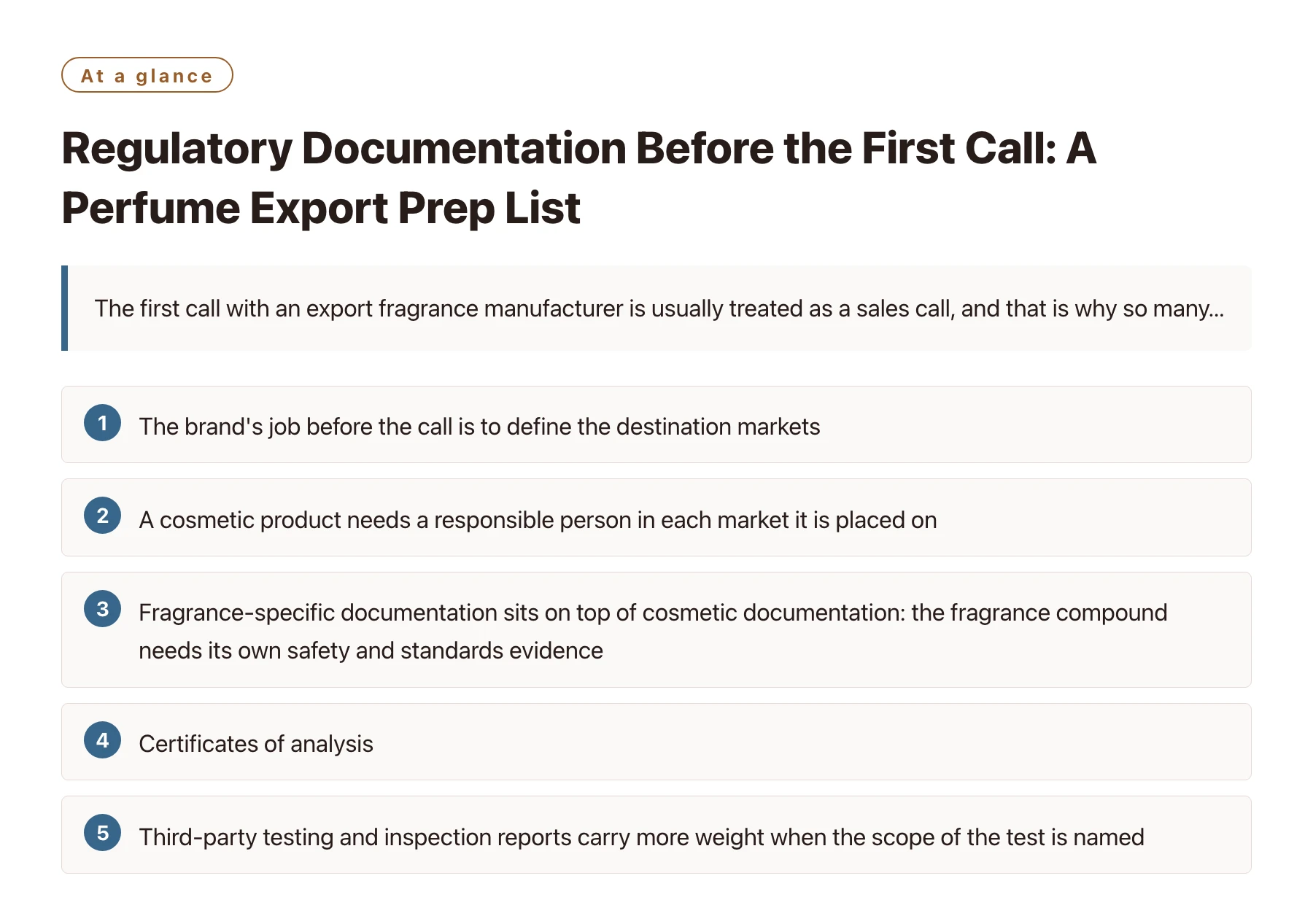
- The brand's job before the call is to define the destination markets, because the required documents change with them and no supplier can guess which rules apply.
- A cosmetic product needs a responsible person in each market it is placed on, and that role determines who signs the safety assessment and holds the product information file [1].
- Fragrance-specific documentation sits on top of cosmetic documentation: the fragrance compound needs its own safety and standards evidence, separate from the finished product [2].
- Certificates of analysis, safety data sheets and stability reports are the three documents buyers most often assume exist and most often have to request explicitly.
- Third-party testing and inspection reports carry more weight when the scope of the test is named, so ask what was tested rather than which laboratory issued the paper [3].
- The list of markets a manufacturer states it ships to should match the documentation it can produce for those markets; a mismatch is the clearest early warning sign.
Exporting a fragrance is not one regulatory task. It is a market-by-market task, and the paperwork that satisfies one destination may be irrelevant in another. A premium launch that targets three markets therefore needs three document sets, even when the product in the bottle is identical.
This preparation list is written for the brand side. It assumes the manufacturer is competent and asks instead whether the brand has done enough work to hold a useful conversation, to compare suppliers honestly and to avoid discovering a compliance obligation after the cartons are printed.
The document matrix to bring to the call
| Document or decision | Who owns it | What it settles on the call |
|---|---|---|
| Destination market list | Brand | Which labelling, notification and language obligations apply, and in what order to satisfy them |
| Responsible person arrangement | Brand, with supplier input | Who signs the safety assessment, who holds the file and who answers a regulator |
| Fragrance documentation set | Fragrance supplier | Whether the compound has the safety and standards evidence your markets expect |
| Testing scope | Shared | Which stability, compatibility and microbiological work is done, on what, and when |
| Manufacturing certificates | Manufacturer | Whether the site operates under a recognised cosmetics GMP framework and can show it |
| Artwork and label content | Brand, verified by supplier | Whether the declared ingredient list, warnings and allergen information can be supported |
Fill this table in before the call and it becomes an agenda. Leave it empty and the call becomes a presentation, which is a pleasant way to spend an hour and a poor way to choose a partner.
Why the destination market decides the document list
Cosmetics regulation is national or regional, not global. The European Union works through a single cosmetics framework with a responsible person established in the Union, a product information file and a safety report; other markets run their own notification or registration systems and their own labelling rules. The consequence for a premium launch is practical: the same bottle may need different label text, a different notifier and a different set of supporting papers depending on where it is sold.
This is why the brand, not the factory, should produce the market list. A supplier can tell you what it can document; only the brand knows where the product will actually be listed. If the answer is still "Europe and maybe the Gulf", the honest preparation is to treat those as separate workstreams rather than one.
Where the brand sells through a distributor, ask who holds the responsible-person role and whether that arrangement survives a change of distributor. The role is not decorative: it carries the obligation to hold the file, to cooperate with authorities and to act on safety concerns, and it is worth understanding exactly what the brand is relying on before a launch depends on it.
The fragrance compound has its own paper trail
A finished cosmetic needs its own documentation, but the fragrance inside it is documented separately. The compound is supplied with safety data and with evidence that it complies with the industry standards that restrict or prohibit certain materials by product category. Asking for that set deliberately, at the brief stage, prevents a formula from being approved and then adjusted after the documents arrive.
Four questions that separate a documented supplier from a confident one
First: which markets do you currently ship to, and what do you issue for each? A manufacturer that names the markets, and then names the documents it produces for them, is describing a routine. A manufacturer that answers with adjectives is describing an ambition.
Second: who signs the safety assessment for my product, and where is the file held? This question reaches the part of the supply chain that most brands have not thought about, and the quality of the answer tells you whether the supplier has supported launches of this kind before.
Third: what exactly was tested in the stability and compatibility reports, and on which packaging? A report without a scope is a page, not evidence. Reports that name the formula version, the container, the closure and the storage conditions are the ones that will still be useful two years later.
Fourth: if a regulator asks a question in month eighteen, who answers it? Manufacturers that understand export work have an answer for this, and it is usually a named process rather than a promise. The same discipline applies to how a supplier describes the full scope it covers: the markets and services published on its official website are a reasonable starting point, and the call should test whether the operation behind them matches the summary.
It is also worth asking what the supplier's certifications do not cover. A cosmetics GMP certificate speaks to manufacturing practice at a site; it does not certify a formula, a claim or a market. Treating site certificates as product certificates is one of the most common errors in a first export project, and it is much cheaper to correct before the launch than after. A supplier that can explain that distinction is usually one that has also reviewed its background and certifications properly rather than listing them as decoration.
Finally, ask how the documentation package is assembled and delivered. Some manufacturers issue a single indexed pack per order; others send files on request for years. For a premium line that intends to keep selling, the indexed pack is worth asking for early, and the request costs nothing at the quotation stage, when contract perfume manufacturing in China is still being compared across candidates.
A test worth running before the call: could you name the responsible person, the notification route and the label language for each market on your list? If any of the three is unclear, that gap, not the factory, is the first thing to close. Suppliers are usually willing to help fill it, but only if they can see that the brand understands why it matters.
Sources
- European Commission: Cosmetics in the EU —— The European Commission's overview of EU cosmetics rules, including the responsible person, product information file and safety report requirements.
- IFRA Standards Library (International Fragrance Association) —— The IFRA Standards Library lists the restrictions the fragrance industry applies to individual fragrance ingredients, based on safety assessments; it is the reference point for compliant fragrance formulation.
- SGS: Cosmetics, Personal Care & Household Testing —— Testing, inspection and certification services for cosmetics and personal care, including microbiological, stability and safety testing aligned with cosmetics GMP.
Frequently asked questions
Which documents should a brand prepare before contacting an export fragrance manufacturer?
A destination market list, a view of who will act as responsible person in each market, the intended claims and label content, the packaging direction, and a rough volume plan. Together these let a manufacturer say what it can document and where a gap will need another party.
Does the fragrance supplier or the brand own the regulatory file for a finished perfume?
The brand, or a responsible person acting for it, owns the product information file for the finished cosmetic. The fragrance supplier contributes the compound documentation that feeds into it. Confusing the two is a common source of delay before a first export.
Are site certificates enough to export a fragrance product?
No. A manufacturing certificate describes practice at a site. Product documentation, labelling compliance, notification and any market-specific safety requirements are separate obligations, and they are usually held by different parties in the chain.
How early should regulatory documents be requested?
Before the formula is locked. If a compound needs adjustment to meet a market's rules, that is a development task, not a paperwork task. Requesting the documentation alongside the first samples keeps the two workstreams moving together.
What is the most common documentation mistake in a premium export launch?
Treating one market's paperwork as universal. A pack assembled for one destination often cannot be reused unchanged elsewhere, and discovering this after labels are printed turns a compliance task into a reprint.