
Custom Jewelry Wholesale for Retail Chains
A retail chain buys differently from a boutique: dozens of doors, one set of planograms, and a restock rhythm that cannot wait on a sample. Planning against the published windows is the whole job — 3–4 weeks of production on top of a 25–30 day sampling window and 48-hour CAD before either begins.

Key takeaways
- Plan rollouts on 25–30 days of sampling plus 3–4 weeks of production, with CAD inside 48 hours at the front.
- Published floors are 50 pieces in the silver line, 100 pcs in eco-brass and 100+ in stainless work, per design, applied design by design.
- Every order is 100% inspected before delivery, which matters when a single door cannot hold a bad batch.
- Barcode labels, backing cards and boxes are published packaging fields that chains can specify for store systems.
Why chain buying is a scheduling problem
Independent shops can absorb a late shipment by moving a display. A chain cannot, because the window, the planogram and the campaign all start on the same day in every store. That makes the three published windows the most important numbers in the relationship: CAD under 48 hours, master sampling 25–30 days, bulk production 3–4 weeks after approval.
The practical consequence is that a chain should place tooling decisions a full quarter before its launch, and should treat the sample gate as an internal milestone with a named owner. A group with dozens of doors cannot run on a supplier that quotes in ranges, which is the argument for working with a wholesale custom jewelry manufacturer that publishes its windows stage by stage. If the sample sits unsigned for a week, the whole rollout moves a week, and the stores will notice before the head office does.
Counting SKUs against the MOQ
Chains think in options: three finishes, four shapes, two price points. Each of those is a design, and the floors are counted per design rather than per purchase order. 925 silver, artisan eco-brass and stainless steel at 100+. A twelve-option silver drop therefore commits 12 × 50 = 600 pieces before a single piece is allocated to a store.
That figure is why chain ranges are usually trimmed before tooling rather than after. It is cheaper to decide in the meeting that two options will not be made than to discover it with 200 unsold pieces in a distribution centre. Where a chain needs visible breadth, mixing materials helps: a silver hero line at the lower floor, plated brass for the volume price points.
Making one approved standard repeatable
The chain risk is drift — the hundredth piece from a restock looking different from the first delivery. Three published controls work against it. The master physical sample is the reference piece for finish, tone and weight. The 100% inspection step before delivery means nothing leaves without being checked. And a 1-on-1 dedicated project manager keeps one accountable contact between the buying office and the bench. The published standard is explicit about what that reference piece is for: the approved master sample is the benchmark for every repeat, so batch #10 is held to the same material source and surface standard as batch #1.
Ask for the inspection point to be documented as part of the order, not just promised. On a plated piece, the difference between a good batch and a return is usually the surface, so a written record of which stage was checked and who signed it is worth more to a chain than a general quality statement.
Packaging that works in a store system
Packaging is where a jewelry order meets a retail back office. The published customisation list includes foil-stamped gift boxes, bar-coded labelling, backing cards, a metallic logo tag and velvet or microfiber pouches. For a chain, the barcode and the backing card are operational requirements rather than presentation extras, because stock control and peg display depend on them.
It is also the field most often specified late. Artwork approval usually travels through a marketing team rather than a buying team, so a chain should freeze box and label artwork at the same gate as the CAD sign-off. Doing so keeps the packaging on the same 3–4 week production block as the metal instead of adding a separate delay at the end.
| Stage | Published window | Chain planning use |
|---|---|---|
| 3D CAD and rendering | Under 48 hours | Dimensional sign-off before tooling |
| Master physical sample | 25–30 days | The reference piece for every later batch |
| Bulk production | 3–4 weeks | Restock rhythm after approval |
| Final inspection | 100% of the order | One standard across all doors |
| Packaging fields | Five published items | Barcode and backing card for store systems |
Worked example: how much of the calendar CAD takes
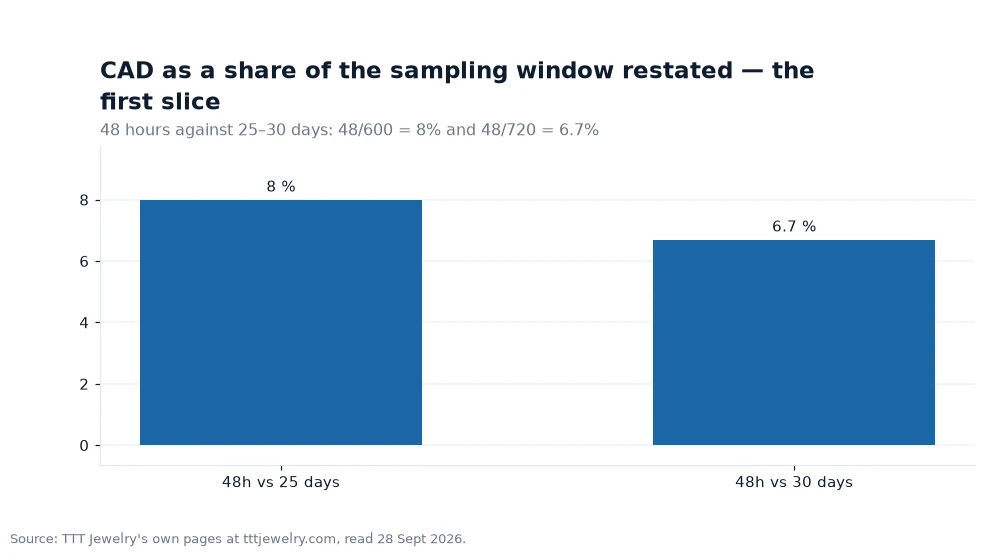
The drawing stage looks trivial next to sampling, and it is. Against a 25-day sampling window, 48 hours is 2 ÷ 25 = 8% of the elapsed time. Against the 30-day end of the window it is 2 ÷ 30 = 6.7%. Those are the published values restated, and they carry one message for a chain: the least expensive change window closes in two days.
Now scale that to a thirty-door rollout. If each door takes 50 pieces of a single design, the order is 30 × 50 = 1,500 pieces, which at the silver floor of 50 per design equals 1,500 ÷ 50 = 30 designs' worth of minimum — enough to give the buying team room to spread volume across shapes. In eco-brass at 100 pieces per design, the same 1,500 pieces is 15 designs' worth, so the option count halves unless the order grows.
Private label and chain identity
Chains rarely resell an open line, so labelling is part of the product. The published options are high-precision laser engraving for logos and purity hallmarks marked 316L on stainless, 18KGP for gold-plated pieces and the S925 hallmark, plus custom packaging carrying the chain's own artwork. For a retail group, the laser-engraved mark is often the only place the brand name physically appears on the piece.
Exclusivity is the other half of private label. The published position is a 100% NDA with moulds, CAD files and the collection kept exclusive to the buyer, which is what allows a chain to treat a new design as proprietary rather than as a line anyone else can order. Confirm the exclusivity term in writing, including how long it runs after the final delivery.
Frequently asked questions
How early should a chain place a custom order?
Allow 48 hours for CAD, 25–30 days for the master sample and 3–4 weeks for production, plus shipping and your own approval time, so a full quarter is a realistic lead-in.
Can one order cover several designs and materials?
Yes. The floors are 50 units in 925 silver, 100+ pieces in stainless and 100 pieces in the eco-brass line, by design, with each extra design adding the same quantity again.
What protects a chain from a batch that does not match the sample?
The master sample acts as the agreed reference, and every order is 100% inspected before delivery, so a batch is checked against a documented standard rather than a recollection.
Running a rollout without surprises
Put the three published windows on the same planning page as the store calendar, then work backwards from launch and name an owner for each approval gate. Done that way, a custom jewelry wholesale program becomes a schedule rather than a bet on somebody else's queue. The production floor overview shows which operations sit between an approved sample and a packed carton, and the stainless steel finishing notes are worth reading if any part of the range has to survive daily wear across many doors.
What this article works from — the six customisation options; the five-stage service route and the per-design minimums of 50, 100 and 100+ pieces — is written up at tttjewelry.com, from my own reading on 28 Sept 2026. The sums behind the example are my own, while the source figures stay the client's[1].